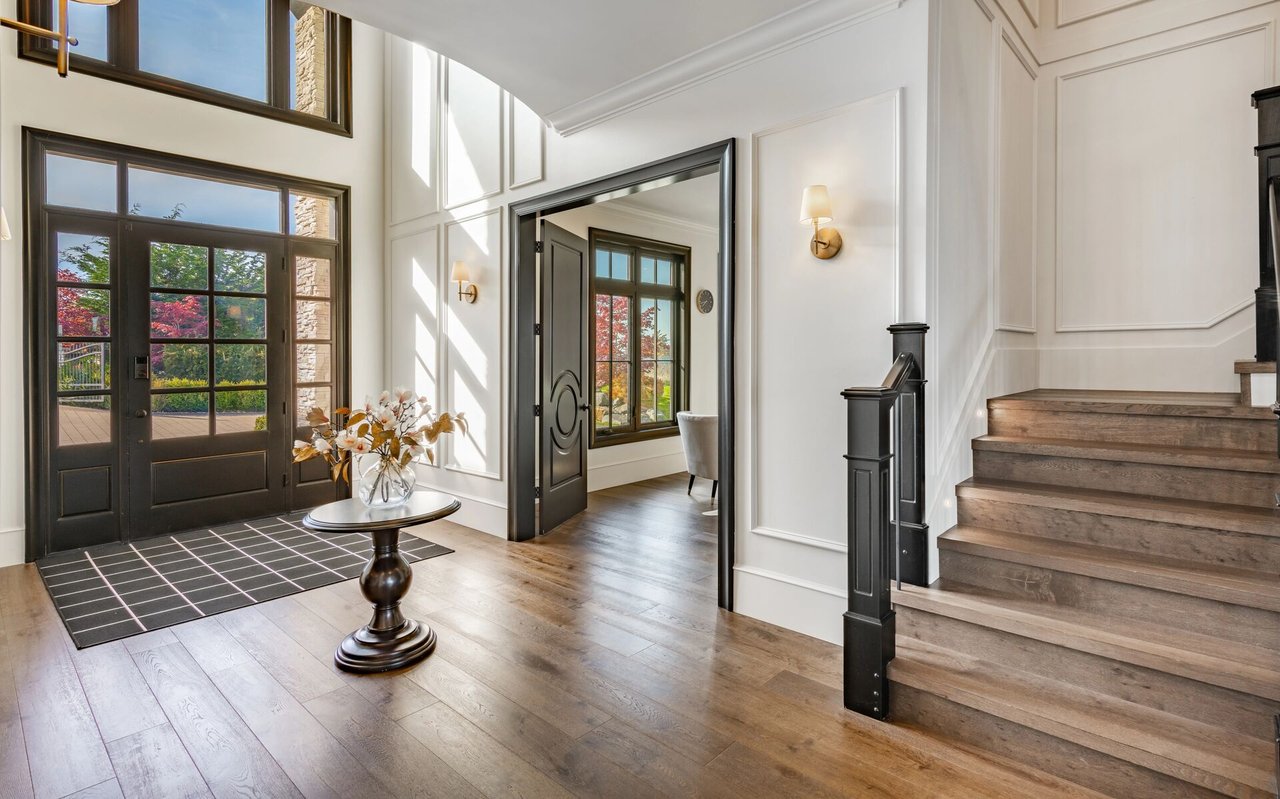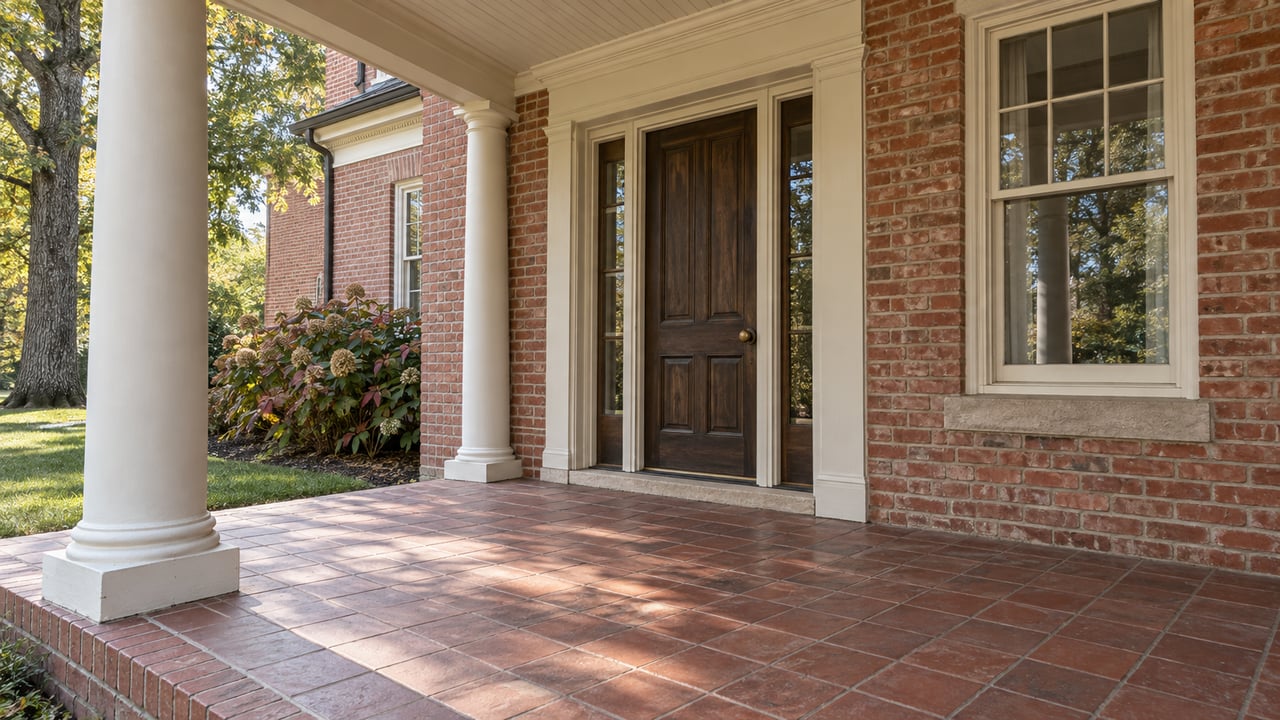
In 1907, John and Angeline Braselton Hosch built a house at 424 Green St. while the former Gainesville First Methodist Church was going up nearby. Most of the church's construction crew also worked on the Hosch home, and some church details ended up inside the house. Explore Gainesville's page for the house quotes Heyward Hosch from an earlier interview with The Gainesville Times. He said "the front stairs are like the choir loft," and he pointed to "a deacon seat in the front room at the foot of the stairs."
That staircase now leads into a bank lobby. On October 7, the Gainesville Times reported that the Hosch home had become the home of Private Bank & Trust. The paper said the house had stood for more than a decade as the only remaining family home on historic Green Street. With that change, Green Street's historic houses are all kept up by the businesses inside them. This conversion started more than fifty years ago, and the street's survival has depended on it ever since.
A street that grew because the square changed
Green Street was a reaction to the square. The original National Register nomination for the district explains that the railroad reached Gainesville in 1870. After that, the business area near the square shifted away from a mix of homes and shops toward stores and warehouses, and wealthier residents went looking for somewhere else to live. Starting around 1880, Green Street became the city's prime residential district.
The houses from that period run from the 1880s through the 1930s. The 1985 nomination that expanded the district groups them mainly as Victorian Eclectic, Neoclassical, Colonial, Georgian and Tudor Revival, and Bungalow and Craftsman. The Hosch House shows this mix in one building. It is an American Foursquare with Neoclassical Revival touches, with sitting rooms near the entry for receiving visitors, a dining room leading to the kitchen, and all the bedrooms upstairs.
So commercial growth helped create Green Street in the first place. Within a few generations, commercial growth reached the street itself.
By 1975, the offices were already moving in
Green Street joined the National Register on August 15, 1975. The nomination for the original district described a stretch of about half a mile, from Glenwood Road to a lot just south of Green Street Place. It said commercial and civic development had already left the residential district isolated.
The nomination named commercial sprawl as a threat. It also documented adaptive reuse that was already happening: offices at 380 Green St. by 1971 and a real-estate agency at 393 Green St. The house at 505 Green St. had become professional offices in 1969, six years before the listing. In 1985, the Green Street-Brenau district nomination joined the Green Street district, the Brenau district and Candler Street School into one larger listing.
From the start, the federal record treated business use as a threat to the street and also as the reason many of its houses were still standing. The occupants listed below show how that worked out over the next fifty years.
The walk, house by house
Explore Gainesville's walking tour names the Boone-Garner-Norton House, the Hosch House, the Nalley-Martin House, the Smith-Palmour-Estes House and the Dixon-Rudolph House among its stops. This table adds the other houses with known occupants and lists them in street-number order.
| Address | House | In use today as |
|---|---|---|
| 380 Green St. | Boone-Garner-Norton House | Lazenby Law Group and Legion Mediation |
| 417 Green St. | Wallace House | Offices for William S. Hardman Jr. P.C., Laila Muhanna Counseling Services, and Lueder, Larkin & Hunter LLC |
| 424 Green St. | Hosch House | Private Bank & Trust headquarters |
| 434 Green St. | Nalley-Martin House | Norton Agency headquarters, since 1990 |
| 446 Green St. | Smith-Palmour-Estes House | Brightstone Transitions, a program serving neurodiverse young adults |
| 505 Green St. | Dorsey-Plaginos-Ellard House | Professional offices, since 1969 |
| 635 Green St. | Dunlap-Burroughs House | The Spa on Green Street |
| 700 Green St. | Dixon-Rudolph House | Mellow Mushroom, since around 2010 |
Most of the houses hold law offices, counseling practices, an insurance agency or a mediation practice. The occupants vary from one end of the street to the other. A spa and a pizza restaurant sit at the north end, where a curious passerby can actually go inside.
The Dixon-Rudolph House at 700 Green St. is the one a passerby is most likely to have been inside. It housed other restaurants before Mellow Mushroom. Explore Gainesville says the house was renovated and opened as Mellow Mushroom in 2010, while a Gainesville Times feature on the building's history put the conversion in 2009. According to the visitor bureau, the 1936 tornado destroyed Mrs. Rudolph's garden at this address. The tornado damage the bureau records at this address is to the garden.
The Nalley-Martin House next to the Hosch House shows how long a single tenant can stay. Norton Agency moved its headquarters there in 1990 and has used the house as a working building for more than three decades. The Hosch family lived at 424 throughout that time.
424, the last house to change
The Hosch House kept its family use much longer than its neighbors did. Explore Gainesville's page, which still describes the family as owners and residents, points out that the property includes a cabin, a garage and a small barn, believed to date to 1898. So the lot may hold some of the oldest structures on that block.
The new occupant is a new institution in its own right. AccessNorthGA reported that Private Bank & Trust cleared its last regulatory steps on Monday, September 28. That day, the Georgia Department of Banking and Finance issued its permit to begin business and the FDIC approved deposit insurance. According to the same report, the initial stock offering raised more than its original $33 million maximum target. After a limited soft opening, the bank opened to the public on Monday, October 5, and held a public grand opening and ribbon-cutting at 5 p.m. on Tuesday, October 6.
Brian Daniel chairs Private Financial, Inc., the bank's parent company, and is president and CEO of Gainesville-based Carroll Daniel, Inc. He told AccessNorthGA that the goal from the start was to bring locally based, relationship-focused banking back to Hall County. The outlet reported that the bank plans personal and commercial banking across the county, with lending and other decisions made locally.
This continues the street's pattern. A locally run institution moved into a house with a documented history, as Norton Agency did at 434 in 1990 and the law offices at 380 did by 1971. The difference this time is that no family homes remain on Green Street.
Before you walk it this fall
The walk is easier with two dates in mind.
- Green Street Place has been closed to through traffic since October 26. City of Gainesville officials announced that Green Street Place, just north of the post office on Green Street, would close between Green Street and Boulevard starting Monday, October 26, for about two months. AccessNorthGA's report says the closure runs 6 a.m. to 6 p.m. daily, parking on Green Street Place is prohibited during the sewer line work, and one lane may stay open for local residents. Questions go to the city's Water Resources Department at 770-538-2456.
- Christmas on Green Street is Sunday, December 6. The city's event timeline lists a 4 p.m. parade and the Rotary Tree lighting at about 5:45 p.m. The parade passes the houses in the table above, including a bank lobby that was a family's front room until this fall.
For a quiet loop, start at 380 and walk north past the Hosch House porch and outbuildings. Stop at 700 for a meal in the Dixon-Rudolph House and finish with the porches at 434 and 446 in evening light. The houses on this route are still in use, kept up by businesses rather than families.
At Rockey Fields, we follow how Hall County's older homes find their next use, from the porch at 424 Green St. to the houses that remain residences on nearby streets. If you own a historic Gainesville home and want to know how its features and history affect what it's worth, let's connect.